


Lotto Champ Reviews 2026 : Best AI Trick Smart Players Use First
NewParts and Tires / Posted 20 hours ago by DN Roney / 6 views
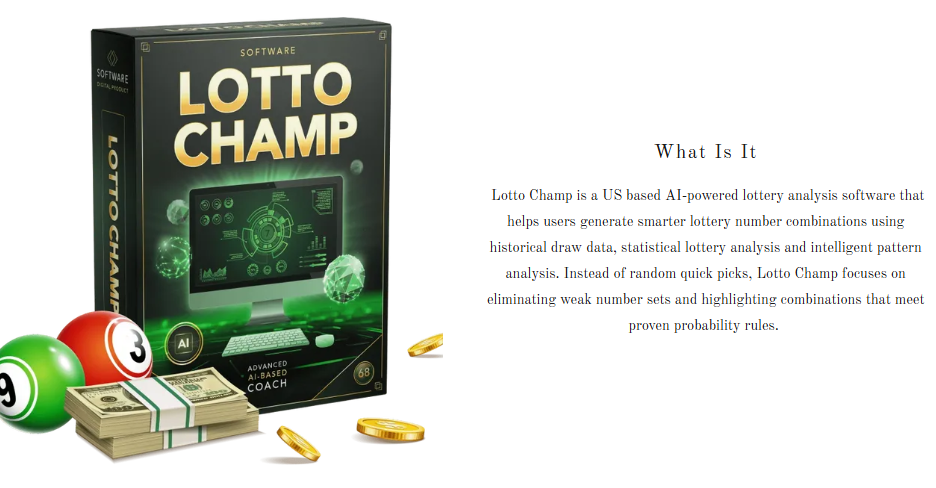
Introduction: Can Artificial Intelligence Beat a Random Lottery?
Every year, millions of people buy lottery tickets hoping to hit life-changing jackpots. At the same time, a new wave of tools claims to use artificial intelligence (AI) to improve number selection.
One of the most talked-about platforms in 2026 is Lotto Champ.
Search trends show growing interest in:
- “Lotto Champ review 2026”
- “Is Lotto Champ legit?”
- “AI lottery prediction software”
- “Can AI beat the lottery?”
- “Best AI lottery system”
But here’s the big question:
Can AI actually outsmart a lottery system designed to be random?

In this deep dive, we’ll examine:
- How lottery systems really work
- Whether AI can predict randomness
- What Lotto Champ claims to do
- The science behind probability
- Pricing & refund policy
- Risk vs reward reality
- Who should (and shouldn’t) use it
- Expert-backed perspective
- Frequently searched questions
- Final verdict
Let’s break it down logically.
Understanding the Lottery: How Random Is It?
Modern lottery systems are designed around random number generation (RNG).
Large state-run lotteries use either:
- Mechanical ball machines
- Certified digital random number generators
These systems are independently audited and engineered to prevent pattern predictability.
Mathematically, lottery draws are modeled as independent events. That means:
- Past results do not influence future outcomes
- Each combination has equal probability
This is grounded in probability theory developed by mathematicians like Pierre-Simon Laplace, who formalized principles of randomness and independent probability events.
For example:
If a lottery requires choosing 6 numbers from 49:
Odds = 1 in 13,983,816.
No pattern exists that can override those odds—unless the system itself is flawed.
👉 Click Here to Visit the Official Lotto Champ Website & Check Current Discount
The Psychology of “Smart Lottery Systems”
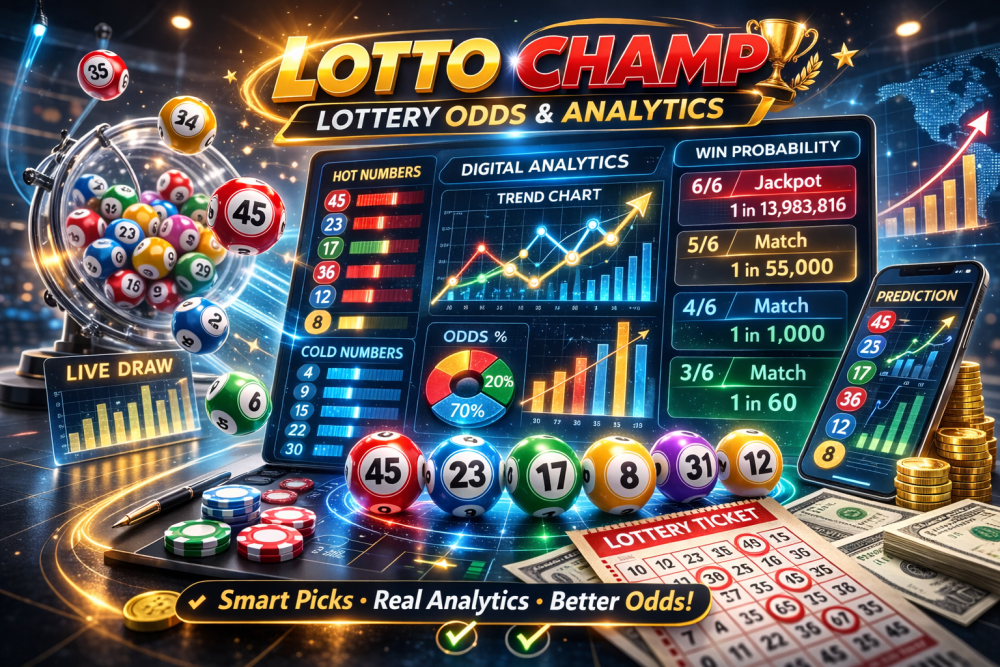
Humans naturally search for patterns—even in random data. This is known as:
Apophenia — the tendency to see patterns in randomness.
Behavioral research by psychologists such as Daniel Kahneman shows people often overestimate their ability to predict random outcomes.
This is why “hot numbers” and “cold numbers” strategies persist—even though statistically they don’t improve odds.
AI tools like Lotto Champ enter this space by claiming to use:
- Pattern recognition
- Historical data modeling
- Algorithmic filtering
- Statistical analysis
But can this truly shift probability?
What Is Lotto Champ?
Lotto Champ is marketed as an AI-powered lottery prediction system that:
- Analyzes past winning numbers
- Identifies frequency trends
- Filters combinations
- Generates suggested number sets
- Claims to increase “small win” frequency
It does not claim to guarantee jackpots—but often implies “smart selection” improves outcomes.
👉 Click Here to Visit the Official Lotto Champ Website & Check Current Discount
The Core Claim: AI Optimization
Lotto Champ suggests that its algorithm:
- Uses machine learning models
- Evaluates statistical frequency
- Removes unlikely combinations
- Generates optimized picks
Machine learning systems typically rely on data modeling techniques rooted in computer science and statistical learning theory, influenced by pioneers like Geoffrey Hinton.
However, machine learning depends on patterns existing in data.
And this is critical:
True randomness contains no exploitable pattern.
Can AI Beat a Truly Random System?

If a lottery draw is genuinely random:
- No predictive model can consistently outperform random chance.
- AI cannot see into future draws.
- Probability remains fixed.
Mathematically, each new draw resets probability.
This is supported by classical probability frameworks introduced by Andrey Kolmogorov, who established axioms of probability theory.
If the system is fair:
AI = Organized randomness filtering
But odds = unchanged.
So What Does Lotto Champ Actually Do?
Based on typical AI lottery tools, likely features include:
✔ Eliminating commonly picked sequences (like 1-2-3-4-5-6)
✔ Avoiding duplicates
✔ Generating evenly distributed number spreads
✔ Providing psychological confidence
What it does NOT do:
❌ Change official lottery odds
❌ Guarantee wins
❌ Predict future numbers
Its value may lie more in structure than prediction.
Lotto Champ Pricing (2026)
Typical offers often include:
- One-time license fee
- Subscription model
- Limited-time discount pricing
- Money-back guarantee (often 60 days)
Prices usually range between:
$37 – $97 depending on promotions.
👉 Check the Latest Official Lotto Champ AI Discount Here

Always verify refund policy before purchasing.
Does Lotto Champ Increase Small Wins?
Some AI lottery tools claim to increase small win frequency.
Possible reasons users may perceive this:
- Avoiding overused number combinations
- Better distribution across number range
- Consistent strategy instead of emotional picks
However:
There is no peer-reviewed scientific evidence confirming AI systems increase lottery profitability over time in fair systems.
Statistical Reality Check
Let’s look at a simple example:
If odds are 1 in 14 million, buying 10 tickets changes odds to:
10 in 14 million.
Still extremely low.
AI cannot fundamentally shift probability laws.
What About “Smart Filtering”?
Smart filtering may:
- Remove unlikely clustering
- Improve balanced selection
- Prevent obvious repeated patterns
But “unlikely” does not mean “impossible.”
In random systems, even unlikely combinations happen eventually.
Scientific References on Randomness
- Kolmogorov (Probability Foundations)
- Laplace (Classical Probability Theory)
- Kahneman (Behavioral Bias & Decision Making)
These foundational works reinforce that randomness cannot be consistently predicted.
👉 Click Here to Visit the Official Lotto Champ Website & Check Current Discount
FAQ
Is Lotto Champ legit?
It appears to be a real software product. Legitimacy depends on refund fulfillment and honest claims.
Can AI predict lottery numbers?
No scientific evidence proves AI can predict truly random draws.
Does Lotto Champ guarantee wins?
No legitimate lottery system can guarantee wins.
Is Lotto Champ a scam?
If it delivers software as described, it’s not automatically a scam. However, exaggerated marketing claims should be viewed cautiously.
Can AI improve lottery strategy?
It can structure number selection—but cannot alter probability.
Pros & Cons
Pros
✔ Organized number selection
✔ Removes emotional guessing
✔ Affordable compared to heavy gambling
✔ Money-back guarantee (if honored)
Cons
✖ Cannot change lottery odds
✖ No scientific proof of predictive power
✖ Marketing hype common
✖ Risk of unrealistic expectations
👉 Click Here to Visit the Official Lotto Champ Website & Check Current Discount
Psychological Benefit Factor
Interestingly, users often feel:
- More confident
- More strategic
- Less impulsive
This alone may improve financial discipline.
But confidence ≠ probability advantage.
Risk Warning: Gambling Awareness
Lotteries are a form of gambling.
Always:
- Set strict budgets
- Avoid chasing losses
- Never treat lottery as income
- Understand odds
Responsible play is critical.
Who Should Consider Lotto Champ?
✔ Casual lottery players
✔ People wanting structured picks
✔ Budget-conscious gamblers
✔ Those aware it doesn’t guarantee wins
Who Should Avoid It?
✖ People expecting guaranteed profit
✖ Individuals prone to gambling addiction
✖ Those believing AI overrides randomness
Final Verdict: Can AI Outsmart the Lottery?
Short answer:
No, AI cannot mathematically beat a fair, random lottery system.
Long answer:
AI can:
- Provide structured selection
- Reduce impulsive picking
- Offer psychological confidence
But it cannot:
- Change probability laws
- Guarantee financial returns
Overall Rating
⭐ 7/10 as a structured number generator
⭐ 3/10 as a “predictive AI system”
⭐ 0/10 as a guaranteed income method
Call to Action
If you want to explore Lotto Champ and test the system yourself (with refund protection):
👉 Click Here to Visit the Official Lotto Champ Website & Check Current Discount
Remember:
Use responsibly. Never risk money you cannot afford to lose.
Conclusion
In 2026, AI is transforming industries—from healthcare to finance. But when it comes to lotteries governed by strict randomness, AI cannot override mathematical probability.
Lotto Champ may offer structure and strategy.
It does not offer a shortcut to guaranteed jackpots.
The smartest move isn’t AI.
It’s disciplined expectations.
- Email : roneyraj112@gmail.com
- Location : USA